
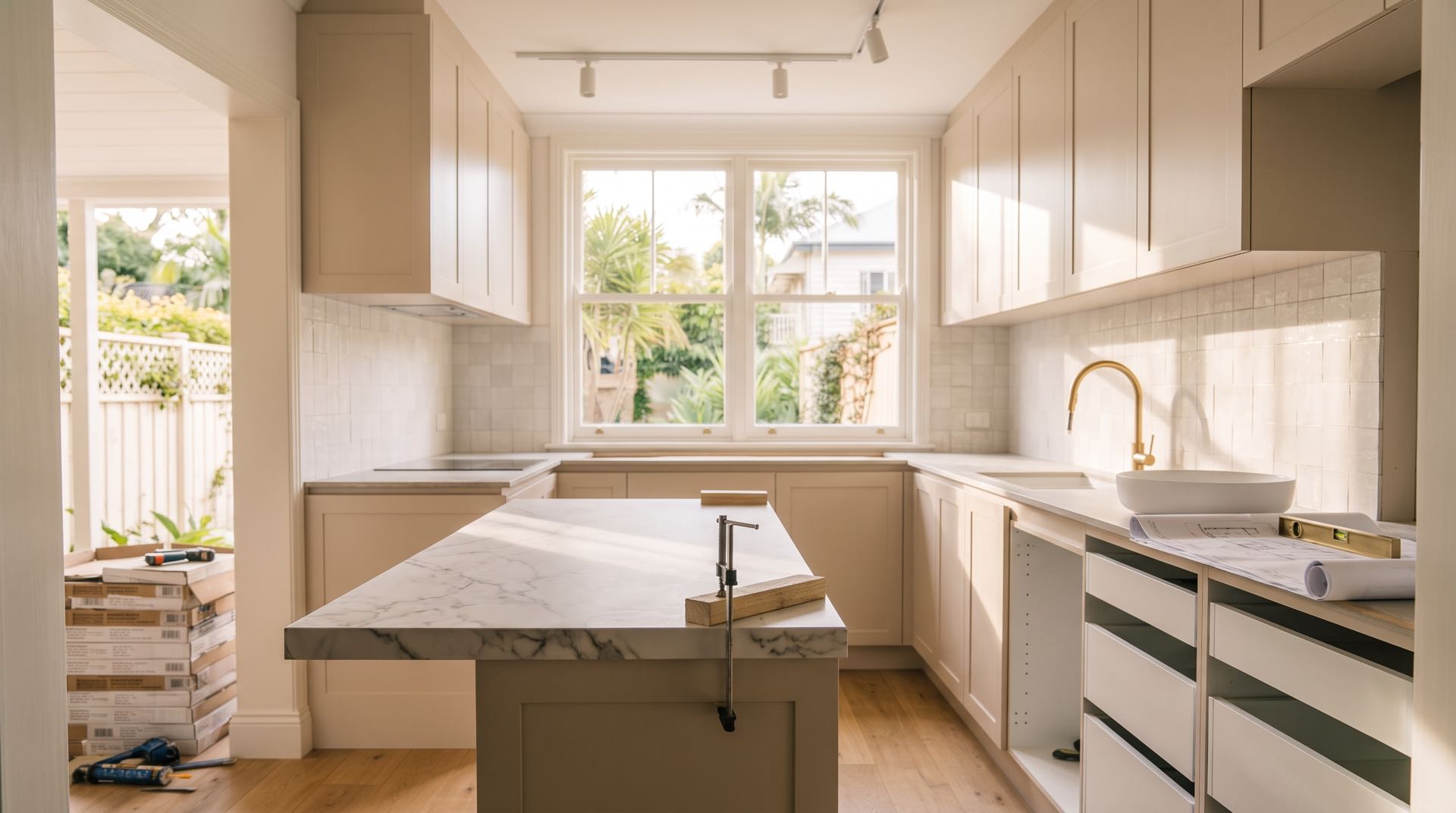
If you're comparing kitchen benchtop materials for a Sydney renovation right now, you've probably noticed the old advice doesn't quite hold up anymore. Caesarstone and Quantum Quartz, the go-to engineered stone brands for the better part of two decades, were banned from sale and installation across Australia from 1 July 2024. That single regulatory change reshuffled the entire benchtop market, and it's still catching out homeowners in suburbs from Castle Hill to Cronulla who are working from renovation guides written before the ban. Cabinetry has shifted too, with more Sydney kitchens moving away from basic laminate toward 2-pac and thermolaminate finishes as buyers get pickier about what a "renovated kitchen" needs to look like to hold its value.
This guide walks through what's actually available to Sydney renovators today, what it costs installed, and which combinations make sense depending on your budget and how long you're planning to stay in the house.
Why Your Benchtop Options Changed in 2024
Safe Work Australia's ban targets engineered stone containing 40% or more crystalline silica, and it applies to manufacture, supply, processing and installation. It doesn't apply to product already installed in your home, so if you've got a Caesarstone benchtop from 2019 you're not required to rip it out. But if you're renovating now, that product simply isn't on the shelf anymore. Bunnings and IKEA pulled their ranges before the deadline even hit.
The driver was silicosis, an incurable and sometimes fatal lung disease caused by inhaling fine silica dust during cutting and polishing. Curtin University's modelling suggested the toll from silica exposure across all trades, not just benchtop fabrication, could run into the tens of thousands of cases over coming decades. For tradies who'd spent years cutting slabs in poorly ventilated sheds, the risk was real and the industry response was, for once, fast.
Kitchen Benchtop Materials Compared: What's Actually on Offer Now
Here's where the money goes, based on current Sydney supplier pricing for a standard 3.5 to 4 metre run, installed:
Porcelain slabs have become the default recommendation from a lot of Sydney kitchen designers, and it's easy to see why. You're looking at roughly $380 to $600 per square metre, they're heat resistant to well over 300°C so a hot pan straight off the stove won't leave a mark, and they don't need sealing. The trade-off is that porcelain chips at the edges if it's knocked hard, and repairs are trickier than with stone because there's no depth of colour to sand back into.
Sintered stone sits above porcelain in both price and performance, typically $500 to $800 per square metre installed. It's essentially porcelain's tougher cousin, pressed under enormous heat and pressure, and it's close to indestructible for domestic use. If you're renovating a kitchen you plan to keep for fifteen-plus years, this is where a lot of Mosman and Vaucluse renovations are landing.
Low-silica engineered stone hasn't vanished, it's just been reformulated. Ranges like Silestone's sub-10% silica lines and Caesarstone's porcelain-hybrid range sit under the regulatory threshold and remain legal. Pricing is broadly comparable to where standard engineered stone used to sit, often $390 to $600 per square metre, though supply in Sydney showrooms has been patchier than porcelain as manufacturers work through the transition.
Natural stone is still around and, for granite at least, still reasonably priced at $450 to $700 per square metre. Marble looks stunning in a north-facing Paddington terrace kitchen but it stains from wine, lemon juice and olive oil if it's not sealed properly, and coastal suburbs like Manly need resealing every six to nine months because of the salt air. Inland, once or twice a year is usually enough.
Laminate remains the budget option at $150 to $300 per square metre, and for a rental property or a kitchen you're planning to renovate again within a decade, it still makes sense. Just know you're likely looking at full replacement within 10 to 15 years rather than a lifetime surface.
Cabinetry: Laminate, 2-Pac and Where the Real Cost Difference Lives
The benchtop gets all the attention, but cabinetry is usually the bigger line item in a Sydney kitchen renovation, and the material choice here matters just as much for how the kitchen ages.
Standard laminate or thermolaminate cabinet doors are the most affordable route and, done well, look genuinely good for the first several years. The catch is the edges. Laminate is applied as a strip over the door's edge, and that strip is the first thing to lift when steam from a kettle or dishwasher gets underneath it, particularly on doors near the oven or sink. Once an edge starts peeling, you're usually replacing the whole door rather than patching it.
2-pac, sometimes written as 2PAC or polyurethane, is a sprayed and chemically cured paint finish applied directly to the door's substrate rather than wrapped around it. There's no edge strip to lift, which is the main reason renovators upgrade to it. It handles moisture and heat better, ages more evenly across the whole kitchen rather than deteriorating first around high-use zones, and minor scuffs can often be touched up rather than requiring a full door swap. It costs more upfront, largely because of the multi-step spraying and curing process, but a lot of Sydney renovators treat it as the finish that actually matches a stone benchtop rather than undercutting it visually.
Flat-Pack Versus Custom Cabinetry: The Real Cost Question
Total kitchen cabinetry in Sydney typically runs from around $5,000 for a small flat-pack fit-out through to $20,000 or more for a fully custom cabinetry and joinery job, and the gap between the two isn't just about the boxes themselves. Flat-pack cabinetry uses standardised carcass sizes, which is exactly why it's cheaper, but it also means your kitchen has to bend to fit the available sizes rather than the other way around. In a lot of older Sydney homes, especially narrow terraces in the Inner West, that mismatch means wasted space or awkward filler panels. If you're exploring budget-friendly updates, kitchen makeovers and cabinet refacing can also preserve sound carcass boxes while giving you brand-new 2-pac door profiles.
Custom joinery costs more because every carcass is built to your actual wall measurements, which matters enormously if your kitchen has an odd angle, a chimney breast, or a window that doesn't sit centrally. If your kitchen is a standard rectangular room with no structural quirks, flat-pack with a 2-pac or laminate finish on top can look every bit as good as custom for a fraction of the price. If your layout is unusual, the money you save on flat-pack often gets eaten up by the workarounds needed to make it fit.
Putting It Together for Your Budget
A sensible mid-range Sydney kitchen renovation right now often pairs porcelain or granite benchtops with 2-pac flat-pack cabinetry, landing somewhere in the $25,000 to $40,000 range depending on kitchen size and how much of the layout is changing. If you're planning a complete overhaul, read our detailed Sydney kitchen renovation budget guide and our breakdown on small kitchen renovation layouts to see how cabinetry and spatial clearance impact costs. For comprehensive projects, explore our full kitchen renovations or book a free kitchen design consultation to preview your benchtop and joinery pairings in 3D before committing.
What doesn't make sense anymore is specifying a benchtop material based on a five-year-old renovation guide or a display kitchen you saw before mid-2024. Ask your supplier directly whether a quoted engineered stone product complies with the current silica threshold, and get it in writing. It's a five-minute conversation that avoids a very expensive problem down the track.